
Stainless steel IBC rental helps you adapt your storage and transport capacity to production needs. The container must still be compatible with your product, volumes and operating conditions. An IBC for a free-flowing raw material will not necessarily meet the same requirements as equipment for a viscous product or a demanding environment.
At Socomat, we help you select an appropriate rental solution. This guide explains how to compare the options and prepare a useful quote request, whether you work in chemicals, food processing, cosmetics or pharmaceuticals.
GRV, IBC or SBC: which container do you need?
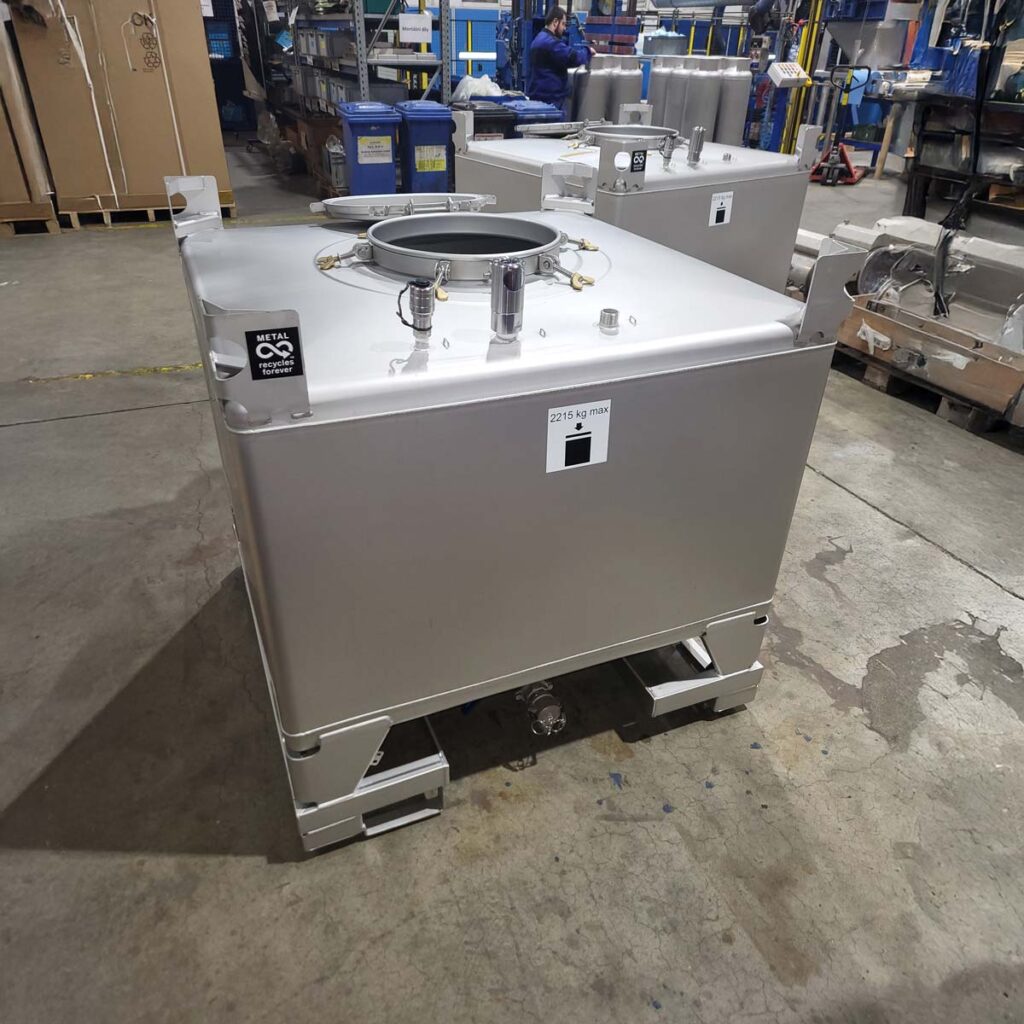
GRV is the French abbreviation for a bulk container. Its English equivalent, IBC, stands for Intermediate Bulk Container. These intermediate containers help organise material flows between storage, production and dispatch, depending on each model’s specifications.
Stainless steel is an option to consider when strength, cleaning and reuse are important selection criteria. Asking for a “stainless steel tank” is not enough: the metal grade, seals, valve and operating conditions must be compatible with your product.
Small Bulk Containers (SBCs) are another family offered by Socomat. The choice between an IBC and an SBC should start with the application requirements, particularly when a specific configuration is needed. These names do not make the equipment interchangeable.
5 criteria for choosing a stainless steel IBC to rent
The right equipment fits your process. Before comparing offers, clarify these five points with your production, maintenance and logistics teams.
1. Product compatibility
Provide the exact product name and its safety data sheet, where available. Specify its concentration, temperature and relevant properties. Compatibility applies to every part in contact with the product: the vessel, seals, connections and discharge components.
For food, cosmetic or pharmaceutical applications, include your cleaning, traceability and quality requirements. Choosing stainless steel does not replace validation of the equipment for your application.
2. Capacity and container rotation
Consider the usable volume per batch and the number of rotations. A 1,000-litre IBC may suit some flows, but its suitability also depends on product density, permissible load and available space.
Calculate the number of containers required by including those being filled, stored, transported and cleaned. This avoids sizing the rental fleet solely around daily production volume.
3. Filling, discharge and handling
Check the connections, discharge height and access to openings. A container suitable for storage may be inconvenient if it cannot connect to your line or if discharge slows production.
Specify the handling equipment available at each site: pallet trucks, forklifts or lifting equipment. Include access and stacking constraints. The available handling options depend on the model and its operating conditions.
4. Temperature and specific equipment
For a viscous product, maintaining temperature may be part of the specification. Socomat’s chemical industry range includes steam or electric heating possibilities depending on configuration, with options for different ATEX environments.
Describe the actual requirement: target temperature, product sensitivity, available power supply and site constraints. A heating option should not be assumed to be available or suitable on every IBC.
5. Rental duration and return conditions
Seasonal demand, an industrial trial and a recurring flow require different rental periods. Share your preferred dates, the number of containers and the collection and return locations.
Compare the full scope of each offer: delivery, cleaning, inspection, maintenance, accessories and return conditions. Ask what is included in the quote and what is charged separately. The rental rate alone is not enough to compare two solutions.
Which rental solutions does Socomat offer?
For the chemical industry, Socomat presents containers from 300 to 3,000 litres, with different constructions and configurations. Materials, linings and equipment must be selected for the product and intended use.
The Small Bulk Containers range covers capacities from 500 to 2,500 litres. It offers further configuration possibilities to assess when a specific requirement goes beyond a standard IBC.
Socomat also offers solutions for food processing, cosmetics and pharmaceuticals. These ranges provide a starting point for discussion; configuration, availability and rental conditions must be confirmed for each project.
Prepare your IBC rental quote request
To receive a suitable proposal, include the following in your message:
• The product to be contained and its safety data sheet, if available.
• Batch volume, number of IBCs and rotation frequency.
• Temperatures, connections and any heating requirements.
• Intended use: storage, process supply or transport.
• Locations, start date and preferred rental duration.
• Cleaning requirements and handling constraints.
Do not have all the details yet? Describe your application and main constraints. The Socomat team can help identify the points to check before selecting equipment.
Frequently asked questions about stainless steel IBC rental
What is the difference between a GRV and an IBC?
GRV is the French name and IBC the English name for the same family of intermediate bulk containers. These terms alone do not specify the material, capacity or permitted uses of a particular model.
Can I rent a 1,000-litre stainless steel IBC?
A capacity of 1,000 litres falls within the chemical industry range presented by Socomat. Availability of a stainless steel model of this size and its suitability for your product must be confirmed when your requirements are assessed.
How much does stainless steel IBC rental cost?
Pricing depends on the configuration, number of containers, rental period and services requested. Ask for a quote specifying rental charges, transport, accessories and return conditions so that you can compare offers on an equivalent basis.
Is a stainless steel IBC suitable for every product?
No. Compatibility must be checked for the product and operating conditions. Cleaning, transport and industry requirements must also be assessed. A container suitable for one application is not automatically suitable for another.
Start your rental project with the right specification
A well-chosen IBC makes daily operations easier and helps avoid late adjustments. Share your product, volumes and schedule with Socomat to explore a rental solution that fits your industrial requirements.


