
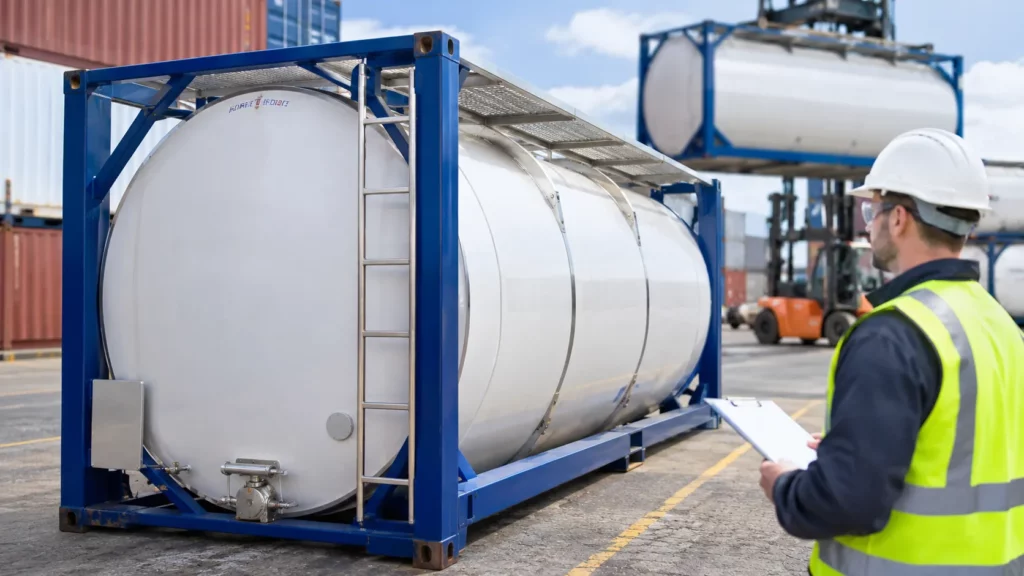
20-foot food-grade ISO tank rental: how to choose a tank and request a quote
Shipping edible oil, syrup or juice in bulk and need a tank for your next shipment? When choosing a 20-foot food-grade ISO tank, start with three details: the quantity per shipment, the unloading conditions and your quality team’s requirements. This information helps you select the equipment and compare quotes on the same basis.
Request a food-grade ISO tank rental quote
When should you rent a 20-foot food-grade ISO tank?
A 20-foot tank container is worth considering for bulk shipments between industrial sites, particularly on routes that use more than one mode of transport. The tank stays in its frame when transferred between compatible modes. Rental can cover a seasonal production run, a trial on a new route or recurring shipments. If you also need on-site buffer storage, flag it early so that use can be assessed separately.
Four things to check before choosing a tank
1. Shipment weight and usable volume
Provide the weight per shipment, the product density at loading temperature and any variation in batch size. This helps match the tank’s capacity to your cargo and the weight limits along the route. Socomat’s 20-foot ISO tank range spans 14,500 to 26,000 litres across different models. Confirm the capacity and suitability for your food product on the specific unit offered.
2. Product temperature and viscosity at delivery
Oil, syrup and juice can have different transfer requirements. Specify the acceptable temperature range, the longest expected transit time and the viscosity at delivery. Ask whether insulation is sufficient or whether a heating option should be assessed. Confirm what equipment the receiving site can provide.
3. Cleaning and traceability
Ask your quality team which records it needs before the tank is released for loading. Agree with the rental provider on what must be documented about food-grade use, previous cargoes, cleaning and product-specific restrictions such as allergens. Confirm who arranges cleaning between shipments and after the final delivery.
4. Connections and receiving-site requirements
Ask both sites to confirm their connections, loading and unloading arrangements, handling equipment and access constraints. If the tank will serve several sites, share the requirements for each one when requesting the quote.
What to include in your Socomat quote request
- The food product, its density and any temperature or viscosity requirements.
- The weight or volume per batch, shipment frequency and number of tanks needed.
- Pick-up and return locations, the intended route and modes of transport.
- The start date, expected rental period and any need for buffer storage.
- Required connections, accessories, cleaning records and traceability documents.
When comparing offers, ask which charges cover equipment rental, repositioning, accessories, cleaning and return. Confirm which services are included and which are quoted separately.
Frequently asked questions
Can a food-grade tank carry any liquid food product?
Suitability depends on the product, the materials it will contact, the cleaning requirements and the conditions of the trip. Share those details before selecting an individual tank.
Can I rent a tank for a single production run?
Socomat offers a range of rental periods. Share your dates and shipment schedule so the team can assess the configuration, rental period and availability.
Get a quote for your next shipment
Already know your product, volume and shipping date? Send those details to Socomat to discuss a 20-foot food-grade ISO tank configuration for your operation.


